Ask three developers to quote the same Telegram bot and you can get $400, $4,000 and $19,000 back. None of them is necessarily lying to you.
This guide gives you the real Telegram bot development cost ranges for 2026 — broken down by bot type, by who you hire, and by what happens after launch. You'll get the price bands, the things that quietly double a quote, an honest answer on when you should not pay for custom development at all, and a scoping checklist you can copy into an email today to get a fixed price instead of a vague range.
No sales pitch until the end. Let's start with numbers.
🚀 Click Here to Discuss Your Custom Bot
What does a Telegram bot cost? The short answer
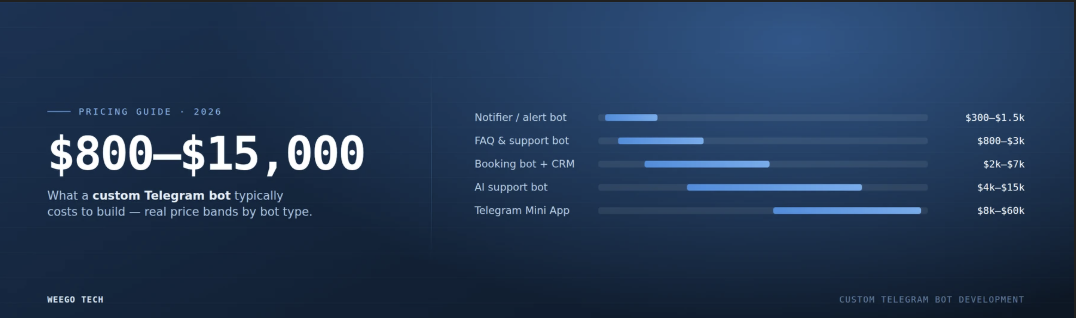
For most businesses in 2026, a custom Telegram bot costs $800 to $15,000 as a one-off build, with the majority of small-business projects landing between $2,000 and $7,000.
Below and above that range:
- Under $500 — a script, not a product. Fine for a personal alert bot, risky for anything customer-facing.
- $15,000–$60,000+ — Telegram Mini Apps, trading bots, or anything with compliance, high volume or a full admin system behind it.
The Telegram platform itself is not what you're paying for. The Bot API is free, has been free since 2015, and charges nothing per message at normal volumes. You are paying for the software around it — the integrations, the edge cases, and the person who fixes it at 2am.
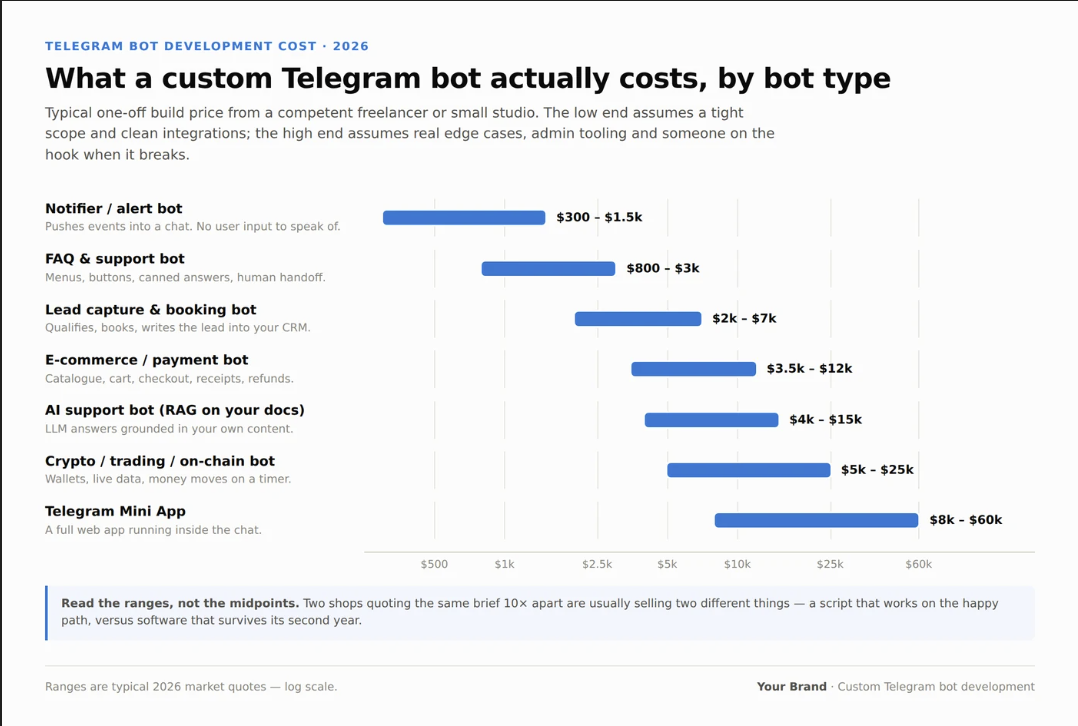
How much does each type of Telegram bot cost?
Price tracks what the bot has to touch, not how clever it looks in a demo. Here's the ladder.
Notifier / alert bot — $300 to $1,500
Pushes events into a chat or channel: new orders, form submissions, server alerts, price changes. No real user input, no state to manage.
This is genuinely a few days of work for an experienced developer. If you're being quoted $5,000 for this, you're paying for someone's sales overhead.
Typical timeline: 3–7 days.
FAQ and support bot — $800 to $3,000
Menu buttons, canned answers, a search over your help content, and a clean handoff to a human when it gets stuck. Rule-based, no AI.
Most of the cost here isn't code — it's mapping your actual support conversations into a tree that doesn't dead-end.
Typical timeline: 1–2 weeks.
Lead capture and booking bot — $2,000 to $7,000
Qualifies a prospect, checks availability, books a slot, and writes the record into your CRM. This is where most business bots live, and where the price starts depending heavily on your systems rather than the bot.
A bot writing into HubSpot via a documented API is a different job from a bot writing into a fifteen-year-old internal system with a login form and no API at all. Same brief, triple the price.
Typical timeline: 3–5 weeks.
E-commerce and payment bot — $3,500 to $12,000
Catalogue browsing, cart, checkout, receipts, order status, refunds. Taking a payment is easy. Handling the failed card, the duplicate charge, the partial refund and the reconciliation report is what costs money.
Typical timeline: 4–8 weeks.
AI support bot with RAG — $4,000 to $15,000
An LLM answering from your documentation rather than making things up. A convincing demo takes an afternoon; a bot that gives a correct answer to a customer 95% of the time takes weeks of retrieval tuning, guardrails and evaluation.
Be very careful comparing quotes in this category — a $2,000 "AI bot" and a $12,000 one may both technically work, and only one of them has been tested against real questions.
Typical timeline: 4–10 weeks.
Crypto, trading and on-chain bots — $5,000 to $25,000
Wallets, live market data, and code that moves money without a human watching. The price premium is almost entirely risk: security review, key management, failure handling, and testing against conditions that only happen at 3am during a crash.
Typical timeline: 6–14 weeks.
Telegram Mini App — $8,000 to $60,000
A full web app running inside Telegram, with the chat as the front door. At this point you are commissioning a web application that happens to live in Telegram, and it costs what a web application costs.
Typical timeline: 6–16 weeks.
What drives Telegram bot development cost up or down?
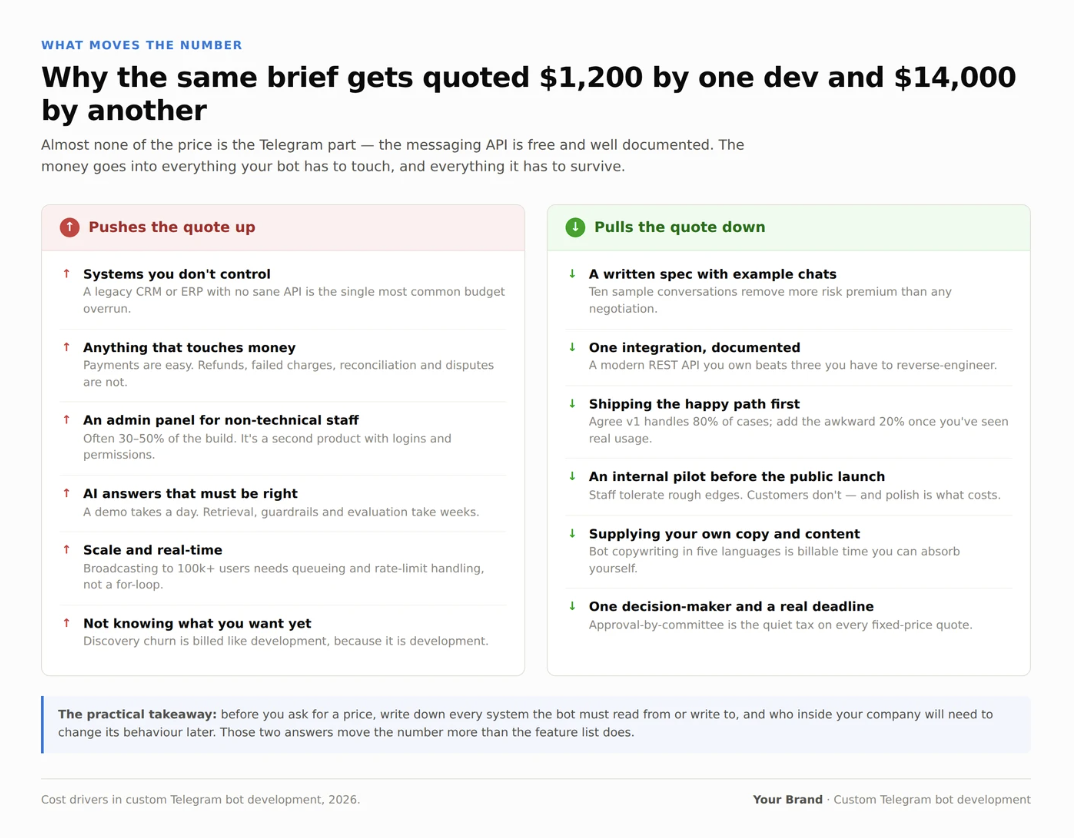
Two things: who you hire, and what they assume you meant.
The first is straightforward. When you hire a Telegram bot developer, the rate depends as much on where they sit as on what they know — offshore rate surveys for 2026 — offshore rate surveys for 2026 put Eastern Europe around $25–$99/hour, Latin America roughly $25–$149, Western Europe $50–$199, and North America $50–$300 depending on the city.
Who you hire Typical rate Simple bot Business bot Best for Budget marketplace freelancer $15–$40/hr $150–$800 $800–$2,500 Prototypes, internal tools, throwaway scripts Experienced independent dev $40–$90/hr $800–$3,000 $3,000–$9,000 Most small-business projects Small specialist studio $75–$150/hr $2,500–$6,000 $6,000–$20,000 Business-critical bots, real support Full-service agency $120–$250+/hr $8,000+ $20,000–$60,000+ Enterprise, compliance, procurement The second reason matters more. A cheap quote and an expensive quote are usually answering different questions. The $900 quote assumes your bot handles the path where everything goes right. The $9,000 quote assumes it handles the customer who types an emoji into the phone number field, the API that goes down on a Friday, and the colleague who needs to change the welcome message without calling a developer.
Neither is wrong. But you should know which one you're buying — and a Telegram bot price that looks like a bargain usually means the scope is narrower than you assumed, not that you found a better deal.
What's actually free, and what isn't?
A lot of confusion about custom Telegram bot development pricing comes from not knowing where Telegram's free platform ends and your bill begins.
Free:
- The Bot API. No licence, no per-message fee, no tiered plans. This is the big one, and it's why Telegram bots are cheaper to run than WhatsApp bots, which bill per conversation.
- Creating and registering the bot via BotFather.
- Normal sending volumes. Telegram's published guidance is roughly one message per second to a single chat, 20 per minute in a group, and around 30 messages per second in bulk across all users.
Not free:
- Hosting — $0 on free tiers for hobby projects, realistically $5–$50/month on a small VPS or managed platform for anything a business depends on.
- High-volume broadcasting. If you need to blast more than ~30 messages per second, Telegram offers paid broadcasts at up to 1,000/second, charged in Telegram Stars per message. It also requires a substantial Stars balance and a large active user base, so it's an enterprise-scale concern, not a startup one.
- Payments. Telegram doesn't take a commission on payments processed through a connected payment provider — you pay that provider's normal fee (Stripe-style rates are typically around 2.9% + $0.30). Digital goods sold inside bots go through Telegram Stars instead, and the economics there are worse than they look: because most purchases happen in the mobile apps, the app-store cut means the effective fee can land north of 30%, with a holding period before you can withdraw.
- AI usage. If your bot calls an LLM, you pay per token, every message, forever. This is the running cost people underestimate most.
The cost nobody puts in the quote: year one
A quote covers the build. Your budget has to cover the year.
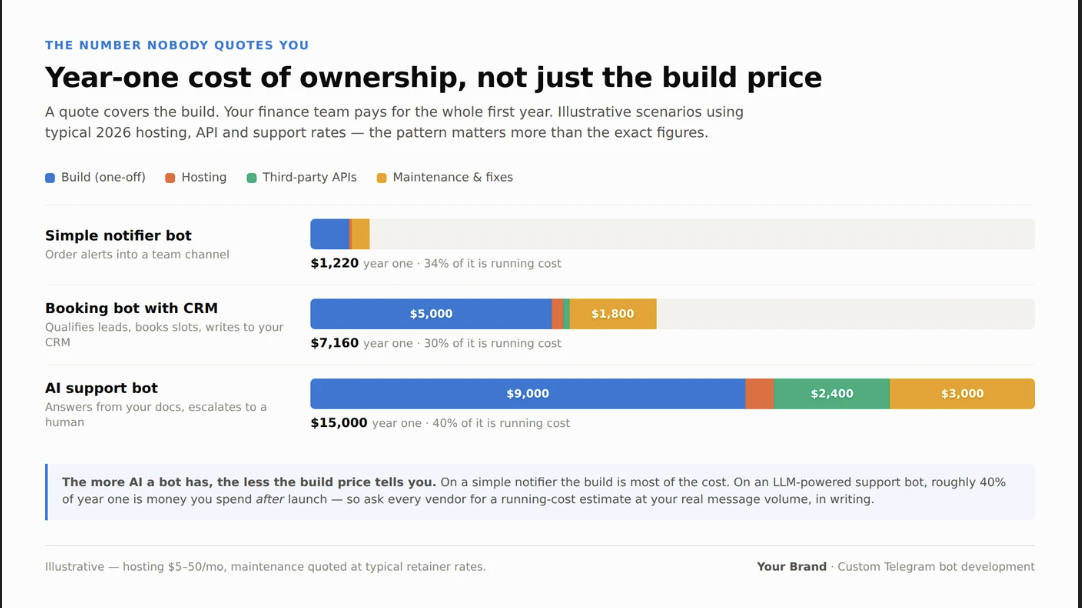
Run the numbers on three realistic scenarios and a pattern appears: running costs are roughly 30–40% of what you spend in the first year.
- A simple notifier bot: ~$800 to build, maybe $420 more across the year.
- A booking bot with CRM integration: ~$5,000 to build, ~$2,200 in hosting, APIs and support.
- An AI support bot: ~$9,000 to build, and around $6,000 more in LLM calls, hosting and maintenance.
Maintenance retainers typically run $50–$150/month for a simple bot and $150–$400/month for something business-critical. That buys you monitoring, dependency updates, and someone who answers when Telegram changes something upstream.
The single most useful question you can ask a vendor: "What will this cost me per month at my actual message volume, in writing?" A good developer will answer in a paragraph. A bad one will change the subject.
Should you build a custom bot at all?
Here is the part most agency pages leave out: for a lot of businesses, custom development is the wrong answer.
If an existing bot or a no-code builder already does 80% of what you need, and you're comfortable with your data sitting on their servers, a $0–$50/month tool will be live this week and will cost less over three years than a custom build.
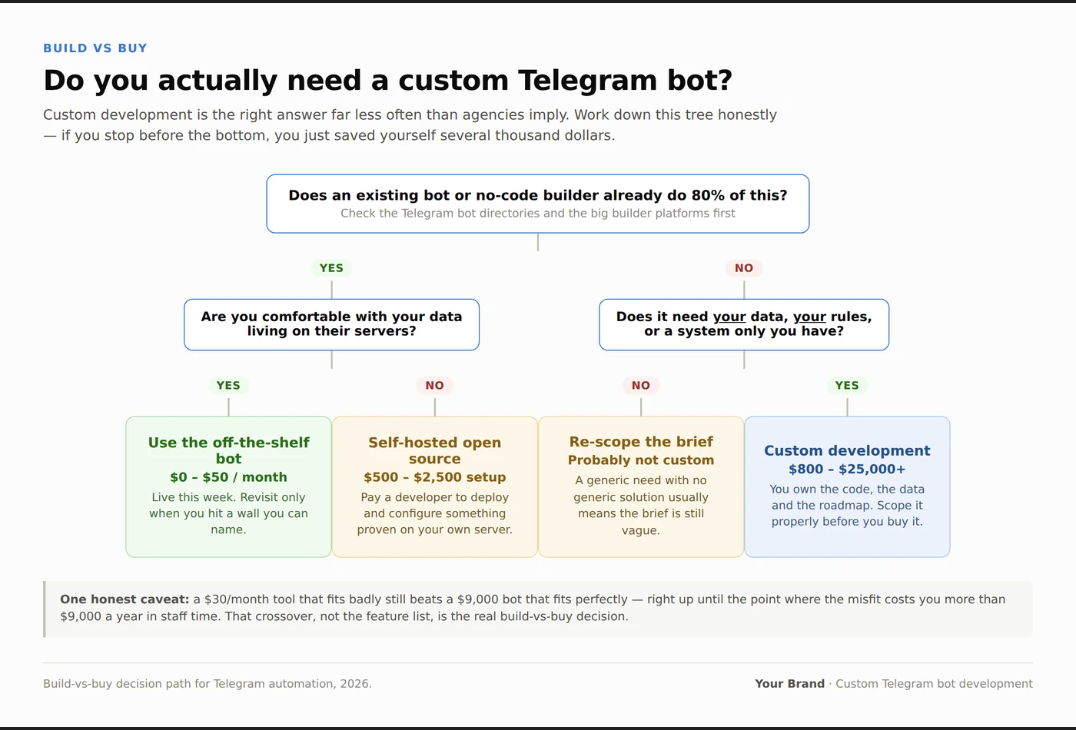
Custom development earns its price when at least one of these is true:
- The bot needs data or logic only you have — your pricing rules, your inventory, your internal system.
- Your data can't live on a third-party platform, for legal or competitive reasons.
- You've outgrown a builder and are paying per-seat or per-message fees that now exceed a build.
- The bot is part of your product, not an internal convenience.
- The misfit of an off-the-shelf tool is costing you more in staff time than a build would cost outright.
That last one is the real test. A $30/month tool that fits badly beats a $9,000 bot that fits perfectly — until the badly-fitting tool burns more than $9,000 a year of someone's time. Work out where your crossover is before you shop.
How to get a fixed price instead of a range
Developers pad quotes to cover uncertainty. Every question you answer up front takes padding out — this is the cheapest cost-reduction lever you have, and it costs you twenty minutes.
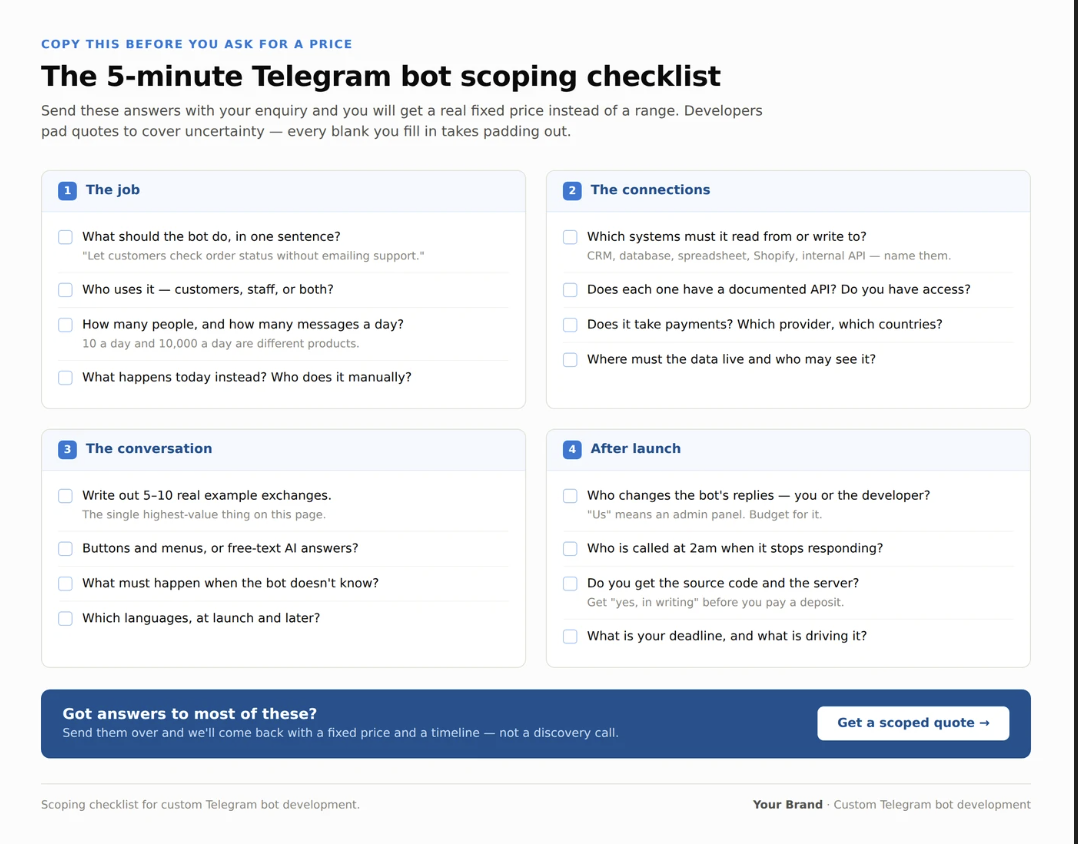
Send these with your enquiry:
1. The job — What should the bot do, in one sentence? Who uses it? How many messages a day? What happens manually today?
2. The connections — Which systems must it read from or write to? Does each have a documented API, and do you have access? Does it take payments, from which countries? Where must the data live?
3. The conversation — Write out five to ten real example exchanges. This is the highest-value thing on the list. Buttons or free-text AI? What happens when the bot doesn't know? Which languages?
4. After launch — Who edits the bot's replies, you or the developer? (If it's you, you need an admin panel — budget for it.) Who gets called when it breaks? Do you receive the source code and control the server? What's your deadline, and what's driving it?
Answer most of those and you should get a fixed price and a timeline back, not a discovery call.
Red flags in a Telegram bot quote
Five things worth walking away from:
- A price before questions. Anyone who quotes your bot without asking what it connects to is guessing, and you'll pay for the guess in change requests.
- Silence on code ownership. Get "you own the source code and it will be delivered to your repository" in writing before any deposit.
- "AI-powered" with no evaluation plan. Ask how they'll measure whether the answers are correct. If there's no answer, there's no testing.
- No staging environment. If they plan to test on your live bot, your customers are the QA team.
- A deposit above 50%. Standard is 30–50% up front, the rest against milestones.
Worth adding: ask who hosts it. If the developer keeps the bot on their own server under their own account, you don't really own it, whatever the contract says.
How long does a Telegram bot take to build?
Roughly, for a competent developer working on a clear spec:
Bot type Timeline Notifier / alert bot 3–7 days FAQ / support bot 1–2 weeks Lead capture & booking 3–5 weeks E-commerce / payments 4–8 weeks AI support bot 4–10 weeks Telegram Mini App 6–16 weeks Add roughly 30% if your integrations aren't documented, and add two weeks if approval sits with a committee rather than a person.
🚀 Click Here to Discuss Your Custom Bot
Frequently asked questions
Is the Telegram Bot API free? Yes. Telegram has offered the Bot API free since 2015 with no per-message charges at normal volumes. You pay for hosting, development and any third-party services your bot calls — not for Telegram itself.
What's the cheapest way to get a working Telegram bot? A no-code builder ($0–$50/month) if a template fits, or a marketplace freelancer ($150–$800) for a simple notifier. Both are reasonable starting points; neither is a good foundation for something customers rely on.
Do I own the source code? Only if your contract says so. Ask explicitly, get it in writing, and have the code delivered to a repository you control — not a zip file emailed at the end.
How much does it cost to maintain a Telegram bot? Budget $50–$150/month for a simple bot and $150–$400/month for a business-critical one, plus hosting and any AI usage on top.
Is a Telegram bot cheaper than a WhatsApp bot? Usually, yes — and the gap widens with volume. The WhatsApp Business API bills per conversation, while Telegram's Bot API doesn't charge per message. For high-volume messaging, that difference can dwarf the build cost.
Can I build a Telegram bot myself? For a personal alert bot, absolutely — BotFather plus a Python script and a free hosting tier will get you there in an evening. The moment real customers or real money are involved, the calculation changes.
Getting a real number for your project
Telegram bot development in 2026 is cheap compared to almost any other channel: the platform is free, the API is stable, and a well-scoped business bot lands in the low thousands rather than the tens of thousands. What makes projects expensive is vagueness — about what it connects to, who maintains it, and what "done" means.
So do the twenty minutes of scoping first. Then get two or three quotes and compare what each one assumes, not just what each one costs.
Ready for a real number? Send us your answers to the four scoping sections above and we'll come back with a fixed price and a timeline — not a discovery call. Get a scoped quote → or message us on Telegram.
Further reading: how businesses are automating with Telegram bots · Telegram bots vs userbots — which one you actually need · our custom development services