Custom Telegram Bot Development in 2026: When It's Worth It, and When It Isn't
Here is something no agency page will tell you. In April 2026, Telegram started letting people build AI bots with no code at all — just a shareable link. A month later it added bots that can be tagged in any chat without joining it.
💬 Get a Free Consultation for Your Custom Bot → Click Here
So before you pay anyone for custom Telegram bot development, the honest first question is whether you need it.
This guide answers that. What custom actually means, what the free tools now cover, exactly where they stop working, what a custom bot can do that nothing else can, and the brief to write so your quote comes back smaller. Written by a team that builds these for a living — including the parts that cost us leads.
What does custom Telegram bot development actually mean?
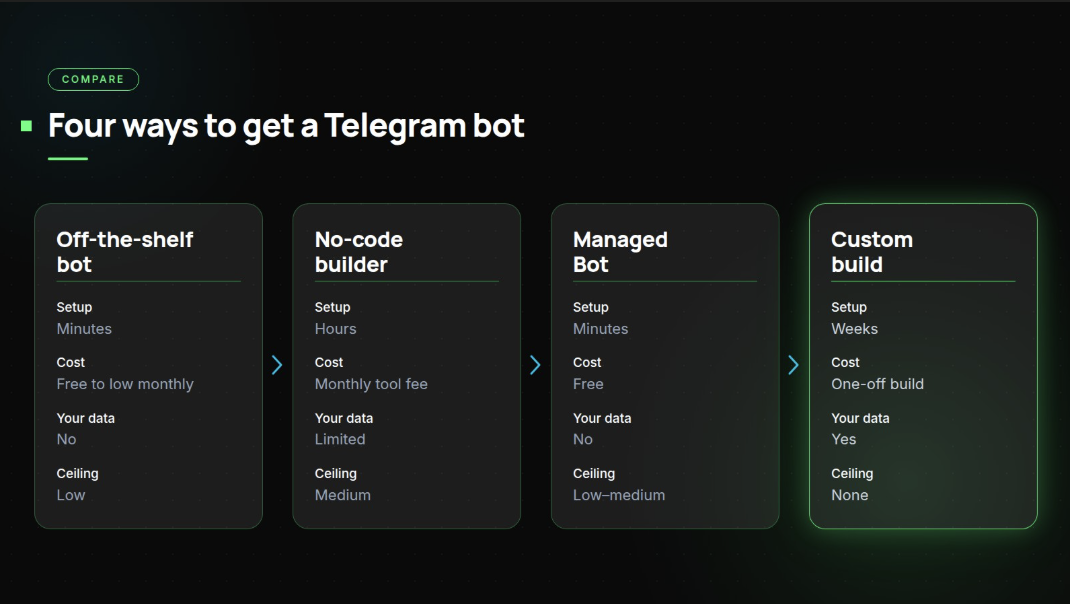
There are four different things people call "a Telegram bot," and they cost wildly different amounts. Getting these straight saves you the most money of anything in this guide.
An off-the-shelf bot. Someone already built it, you add it to your channel, you pay a small monthly fee or nothing at all. Forwarding bots, welcome bots, support bots. Setup takes minutes.
A no-code builder. You drag boxes around in a web tool and it produces a bot. Fine for simple question-and-answer flows. You are renting the tool, and your bot stops working the day you stop paying.
A Managed Bot. Telegram's own no-code option, added in Bot API 9.6 on 3 April 2026. You create a private AI bot instance from a link. No developer, no server, no monthly tool fee.
A custom bot. Someone writes code for you. It runs on a server you control, talks to your own database and your own systems, and does exactly what your business does — not what a template thinks your business does.
Custom Telegram bot development means the fourth one. The other three are worth trying first, and I mean that.
Do you actually need a custom bot in 2026?
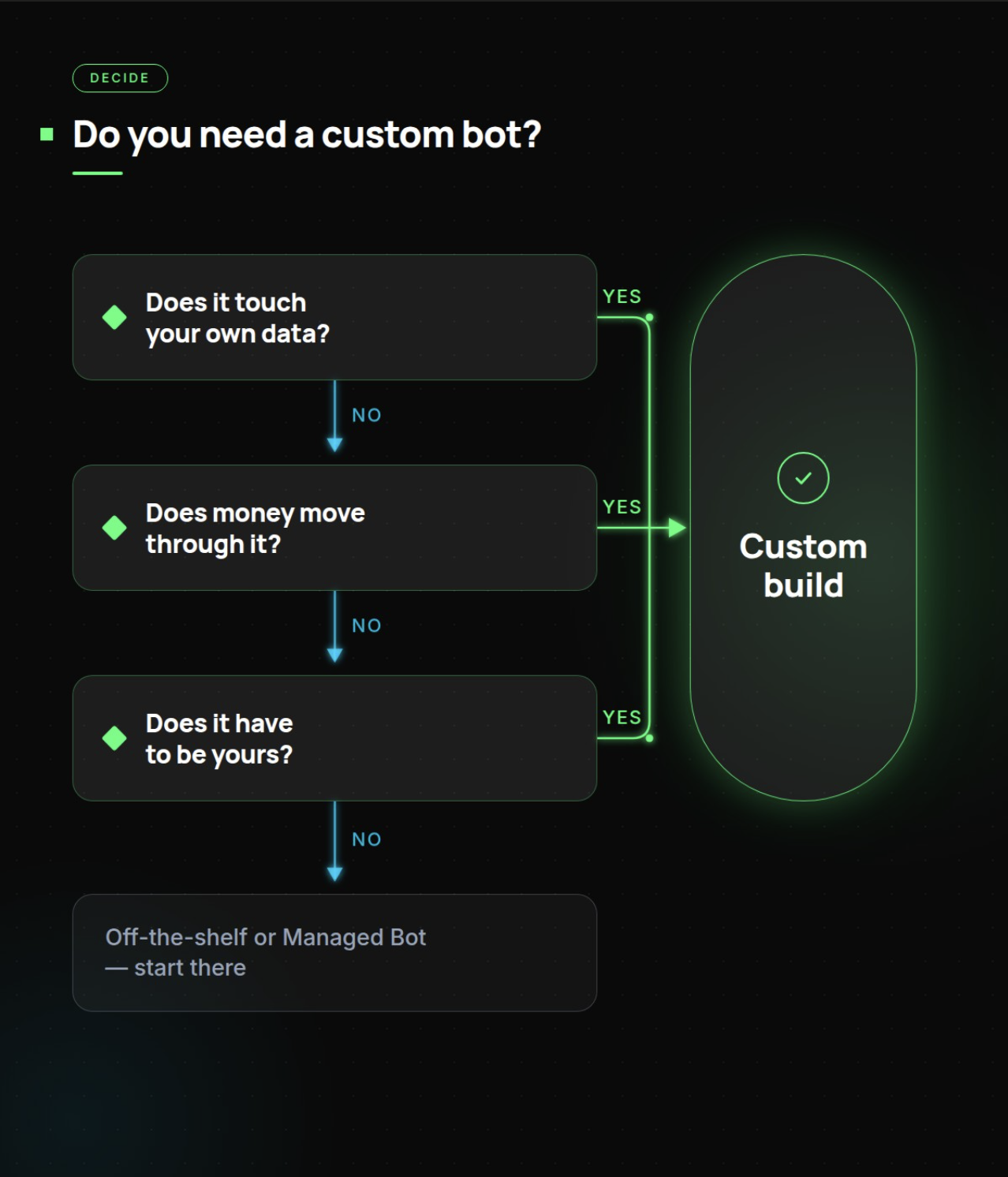
Use three questions. If you answer no to all three, do not hire anyone yet.
Does the bot need to touch your own data? If it has to read your orders table, check a customer's subscription, or write into your CRM, you need custom. Free tools cannot reach inside your systems.
Does money move through it? Payments, refunds, subscriptions, wallet balances, anything you would be embarrassed to get wrong. Custom, every time.
Does it have to be yours? If the bot is part of your product, or you need to sell the company one day, or you cannot have a third party sitting in the middle of your customer conversations — custom.
If all three are no, you are probably looking at an off-the-shelf bot or a Managed Bot, and you will be running by tomorrow instead of next month.
What does Telegram now give you for free?
This is the part that moves fastest, and it is why a quote you got in 2024 is out of date.
Managed Bots (Bot API 9.6, 3 April 2026). Private AI bot instances created from a link, no code required. Good for straightforward question-answering.
Guest AI Bots (7 May 2026). You can tag a bot in a chat it hasn't joined, and it only sees the messages it was tagged in. Useful, and much less invasive than adding a bot to every group.
Bot-to-bot chats (7 May 2026). Bots can now talk to other bots. This is what makes chained, autonomous workflows possible.
Streaming replies (7 May 2026). Bot answers appear word by word as they are generated, instead of the user staring at nothing for four seconds.
Rich messages (Bot API 10.1–10.3, June to August 2026). Structured text, expandable quotes, new button types, disabled button states. Bot API 10.3 landed on 24 August 2026.
Any developer quoting you should know all of this. If they don't, that tells you something.
Where do free and no-code bots stop working?
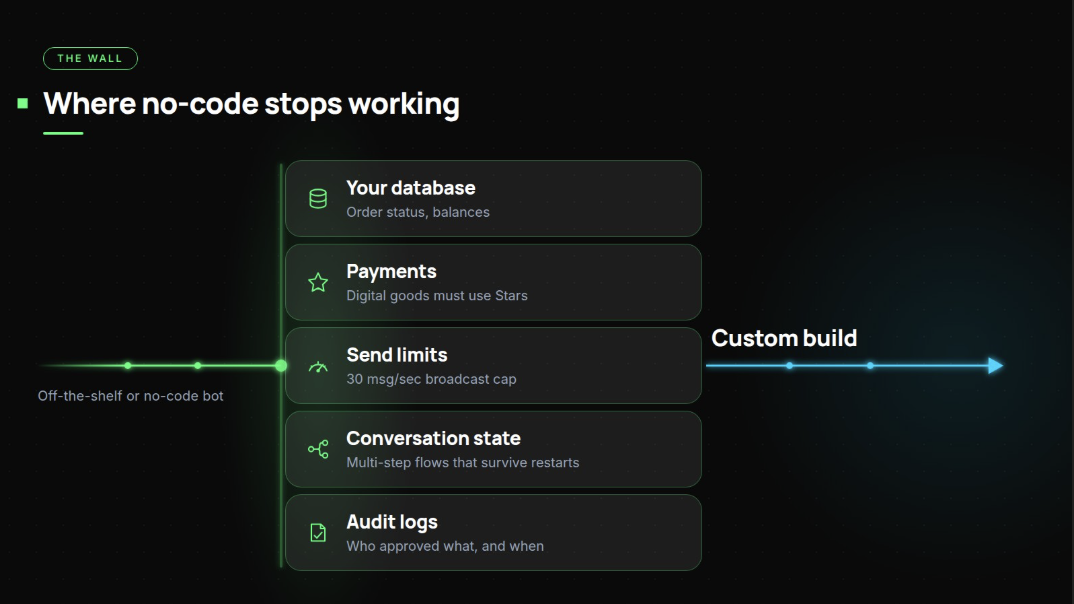
Five walls. Every custom project I have worked on hit at least one of them.
Wall 1 — your database. The moment the bot has to answer "what's my order status," it needs to reach into your systems. No-code tools cannot do that safely.
Wall 2 — money. Telegram requires that anything digital sold inside a Telegram app is paid for with Telegram Stars. Only physical goods and services can use normal card payment providers. That rule shapes your entire build, and it surprises people late and expensively.
Wall 3 — sending limits. Telegram's own published limits: one message per second in a single chat, 20 messages per minute in a group, and around 30 messages per second for bulk broadcasts. Paid broadcasts go up to 1,000 per second at 0.1 Stars per message — but only once your bot has at least 100,000 Stars and 100,000 monthly active users. If you are planning to message 50,000 people, the queue design is the project.
Wall 4 — real conversation state. A bot that remembers where a user is in a seven-step process, handles them going backwards, and survives a server restart is a state machine. Builders fall apart here.
Wall 5 — proof. Audit logs, who approved what and when, data that stays in your own country. If you need any of it, you need your own server.
What can a custom Telegram bot do for a business?
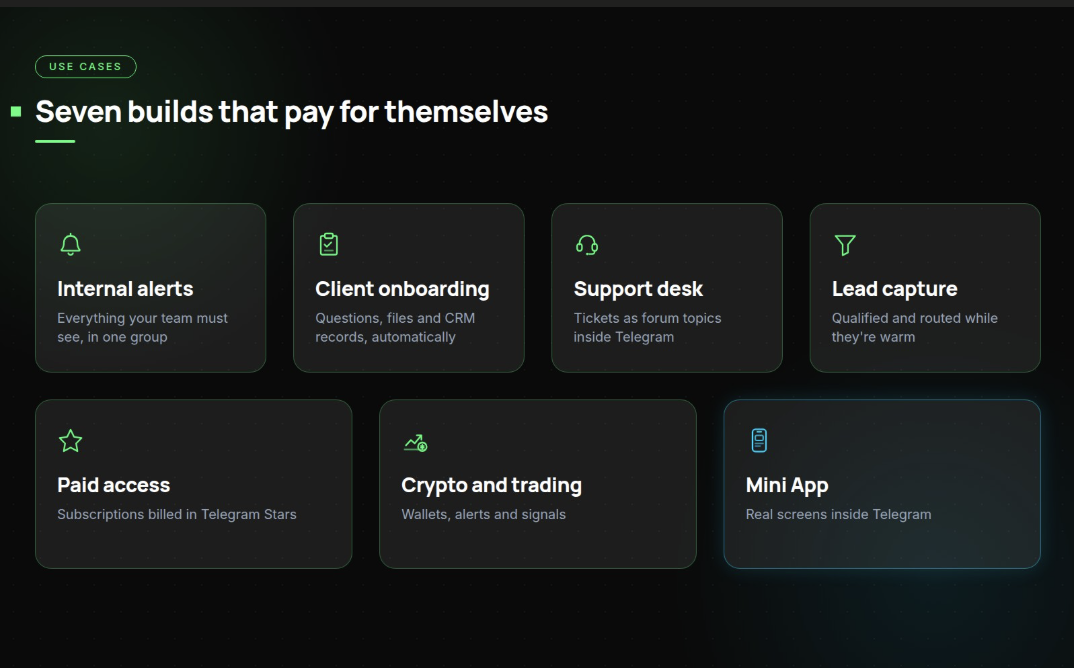
Seven builds that earn their money back. These are the ones that come up again and again.
Internal alerts. Your servers, payments, sign-ups and errors all report into one Telegram group, formatted and filtered so your team actually reads them. Cheapest bot to build, fastest payback.
Client onboarding. New client answers questions in the chat, files get collected, records get created in your CRM, your team gets pinged. Replaces a form, three emails and a follow-up call.
A support desk inside Telegram. Customer messages the bot, a ticket opens as a forum topic, your team replies from inside Telegram, and nothing gets lost.
Lead capture into your CRM. The bot qualifies, tags and routes the lead while they are still interested, instead of a form that sits in an inbox overnight.
Paid access and subscriptions. Sell access to a channel or a tool, take payment in Stars, add and remove members automatically when people join or lapse.
Crypto and trading bots. Wallet connections, on-chain alerts, signal delivery, portfolio tracking. Most demanding category, and the one with the least room for mistakes.
A Mini App. When buttons and text are not enough and you need real screens — a storefront, a dashboard, a booking calendar — running inside Telegram.
Bot or Mini App — which one do you need?
People use these words as if they mean the same thing. They don't, and picking the wrong one is an expensive mistake.
A bot is a conversation. Messages, buttons, menus, files. It is fast to build, cheap to run, and works fine for anything that can be expressed as a back-and-forth: alerts, support, onboarding, approvals, simple ordering.
A Mini App is a screen. A real web app that opens inside Telegram, with layouts, forms, images and navigation. A product catalogue, a booking calendar, a dashboard, a wallet.
The simple test: sketch your flow on paper. If you can draw it as a list of messages and buttons, build a bot. If you find yourself drawing boxes and a grid, you need a Mini App — and a Mini App costs several times more, because you are now building a web app as well as a bot.
Most projects that think they need a Mini App actually need a bot with better buttons. It is worth an honest hour with someone before you commit to the bigger number.
What does it cost to keep a bot running?
This is the line missing from most quotes, and it is the one that annoys people six weeks after launch.
A server. A small bot runs happily on a cheap VPS. Budget a few dollars a month, more if it does heavy work or stores a lot.
Monitoring. You need to know when the bot stops responding — ideally before a customer tells you. This is small but it is not free.
Bot API updates. Telegram shipped five Bot API versions in 2026 alone. Nothing breaks overnight, but a bot that is never touched slowly falls behind what users expect.
Someone to fix things. An hour here and there. Either you keep the developer on a small retainer, or you accept that a bug waits until they have time.
None of this is expensive. It just needs to be in the plan rather than a surprise.
How much does custom Telegram bot development cost?
Short version: a simple alert bot usually starts in the low hundreds of dollars, a support or lead bot lands in the low thousands, and a full Mini App runs into five figures. Agencies on page 1 publish similar bands — around $3,000 to $8,000 for a simple bot and $20,000 to $50,000 for a Mini App.
I am not going to repeat the whole breakdown here, because we already published it with every band, what pushes a quote up or down, and the year-one costs nobody puts in the proposal.
Read that first: Telegram bot development cost in 2026.
What should go in your brief?
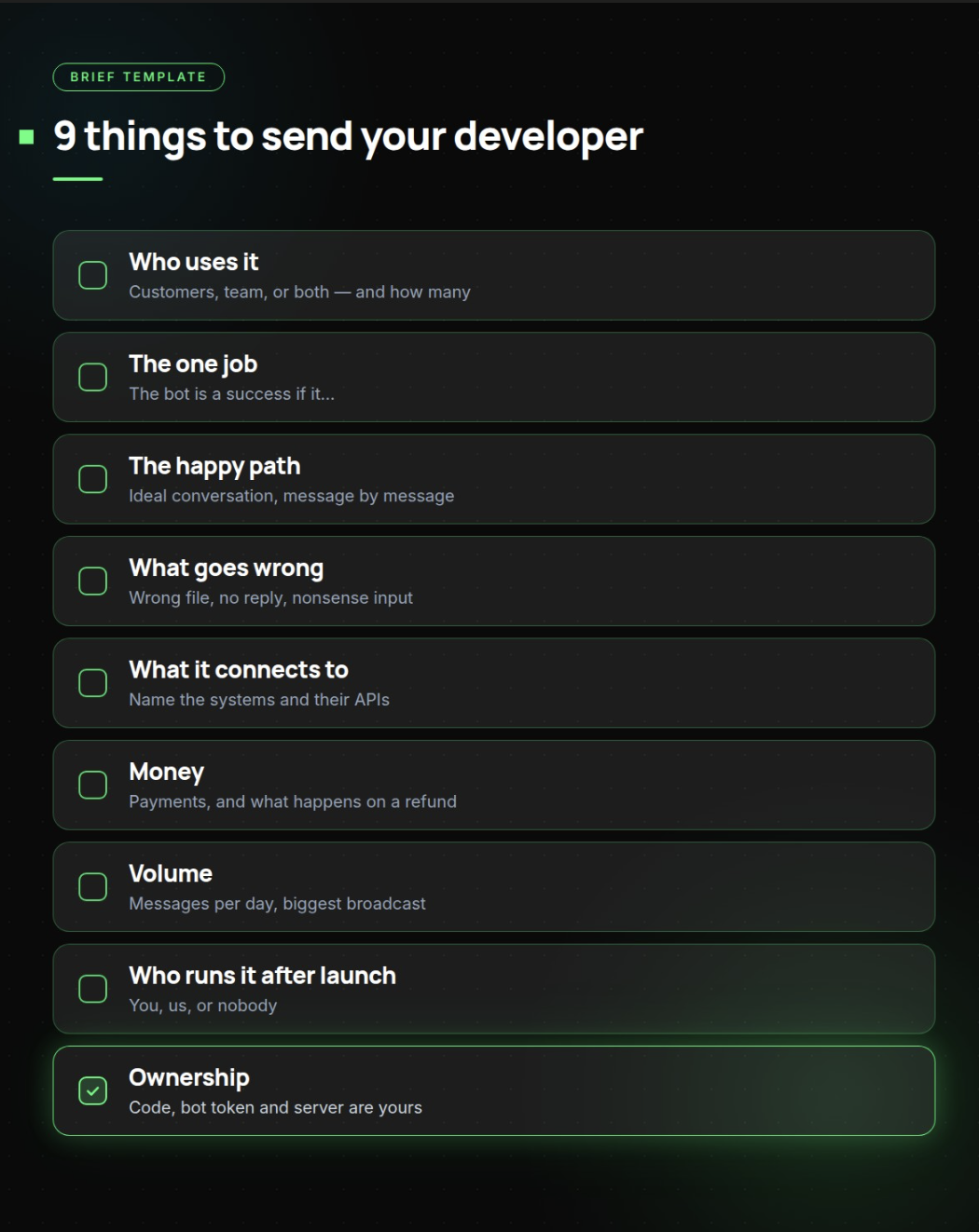
This is where you save real money. A vague brief gets a padded quote, because the developer is pricing your uncertainty. Answer these nine things and your number comes back smaller and firmer.
- Who uses it — customers, your team, or both, and roughly how many.
- The one job — finish this sentence: "The bot is a success if it ___."
- The happy path — the ideal conversation, written out message by message.
- What goes wrong — wrong file, no reply for two days, someone types nonsense.
- What it connects to — name the systems, and say whether they have an API.
- Money — does the bot take payments, and what happens on a refund.
- Volume — messages per day, and biggest single broadcast you will ever send.
- Who runs it after launch — you, us, or nobody, and what "nobody" means.
- Ownership — you should own the code, the bot token and the server. Say so.
If you send those nine answers to three developers, you will get three comparable quotes. If you send "I need a Telegram bot," you will get three guesses.
How do you choose a Telegram bot development company?
Ask five questions. The answers separate a real developer from a reseller very quickly.
"Who owns the bot token, the code and the server?" The only acceptable answer is you. If the bot token lives in their account, they can switch off your business.
"What happens when we hit Telegram's send limits?" A good answer mentions queueing and the 30-per-second broadcast cap. A bad answer is "that won't happen."
"How do we take payments?" They should immediately say Stars for digital goods. If they suggest a card gateway for digital products, they have not read the rules.
"Show me a bot you built that is still running." Not a screenshot. A live bot you can message right now.
"What does month two cost?" Servers, monitoring, Bot API updates, bug fixes. Anyone who says zero is either hiding it or has not run a bot in production.
Red flags
A fixed price quoted in the first reply, before anyone has asked what it connects to. A refusal to hand over the code. A quote that never mentions hosting. And a developer who has not heard of Managed Bots or Bot API 10.x — the platform moved three times this year alone.
When is an existing bot the smarter call?
Plenty of times, and we would rather tell you now than three weeks into a build.
If you want to forward or copy posts between channels, that is a solved problem — use ForwardBuddy instead of paying for a custom forwarder. Same for cloning a channel with its old posts or forwarding without the "forwarded from" tag.
If you want to auto-approve join requests or send welcome messages, Channel Guru does it in about two minutes. Our guides on auto-approving join requests and Telegram welcome messages walk through it.
If you want a basic support inbox, start with SupportBuddy or another tool from our support bot comparison before commissioning anything.
Custom is the right call when your process is genuinely your own. It is the wrong call when you are paying to rebuild something that already exists for free.
How long does a custom Telegram bot take?
A simple alert bot: a few days. A support or lead bot with one integration: two to four weeks. A Mini App: four to eight weeks, which matches what the larger agencies publish.
The thing that stretches a timeline is almost never the code. It is waiting for access to your other systems, and waiting for someone on your side to decide what the bot should say.
Frequently asked questions
Is the Telegram Bot API free? Yes. Telegram does not charge for the Bot API. What you pay for is the developer who writes the bot and the server it runs on.
Can a Telegram bot take payments? Yes, but with a rule. Anything digital sold inside a Telegram app must be paid for with Telegram Stars. Physical goods and services can use normal card payment providers.
Who owns the bot after it is built? You should — the code, the bot token and the server. Get it in writing before work starts.
What is the difference between a Telegram bot and a Mini App? A bot works in the chat with messages and buttons. A Mini App is a real app with screens that opens inside Telegram. If your flow needs more than buttons, you need a Mini App.
Can a custom bot connect to my CRM? Yes, if your CRM has an API. That is one of the main reasons people go custom in the first place.
How many people can my bot message at once? Roughly 30 per second on the free tier. Paid broadcasts reach up to 1,000 per second, but only after your bot has 100,000 Stars and 100,000 monthly active users.
Do I need a developer now that Telegram has no-code bots? Not always. Managed Bots handle simple question-and-answer cases well. You need a developer the moment the bot has to touch your data, move money, or be yours.
Where to start
Do the cheap thing first. Try an existing bot or a Managed Bot for a week. You will learn what you actually need far faster than any planning document will teach you.
When you hit one of the five walls — your database, payments, send limits, real conversation state, or audit trails — that is the moment custom Telegram bot development becomes worth paying for. Come with the nine-point brief and you will get a straight number instead of a range.
Building something specific? Tell us what it needs to do and we'll tell you honestly whether it needs a custom build — or whether one of our existing bots already does it.